
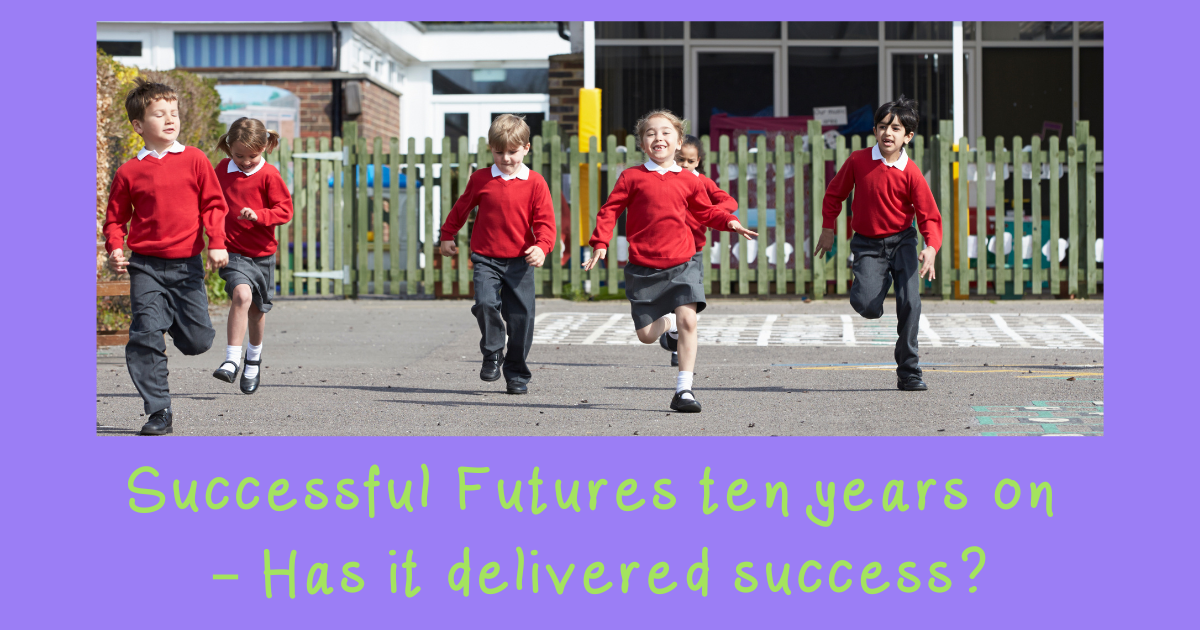
It’s been a decade since the publication of Successful Futures, the review by Professor Graham Donaldson into curriculum and assessment arrangements in Wales.
The landmark report led to the development and eventual implementation of Curriculum for Wales, one of the biggest and most radical overhauls to the education system in Wales for decades.
With the ten-year anniversary of Successful Futures upon us, we decided to revisit the original document to review the changes that have taken place since its publication and ask – has Successful Futures delivered success?
The context
When Successful Futures was published in 2015, the education system in Wales had already been through a period of significant reform:
- The Foundation Phase, the experience-led curriculum for three to seven-year-olds, had been introduced in 2010, with the aim of transforming the way early years education was delivered.
- The National Literacy and Numeracy Framework, which set out a continuum of progression for pupils’ learning in literacy and numeracy from Reception to Year 9, had become a statutory curriculum requirement in 2013.
- And the Welsh Government’s Welsh-medium Education Strategy, launched in 2010, had set high expectations for improved Welsh skills among pupils.
In addition, the international PISA results published in 2013 showed Wales had again fallen further behind the other UK nations in reading, maths and science.
Contact Impact Wales today to get support with your curriculum design process.
The report
Professor Graham Donaldson presented his review in January 2015, just ten months after he was originally commissioned by the Welsh Government. The Successful Futures report was then published the following month.
The report outlined a “radical and wide-ranging” set of proposals for the future direction of education in Wales. In his summary, Professor Donaldson wrote: “[The proposals] build on the many existing strengths of Welsh education and aim to provide both a vision for the future and a means of realising that vision that is coherent and manageable.”
It recommended the curriculum be designed around four core purposes, that ensure children and young people develop as:
- ambitious, capable learners, ready to learn throughout their lives
- enterprising, creative contributors, ready to play a full part in life and work
- ethical, informed citizens of Wales and the world
- healthy, confident individuals, ready to lead fulfilling lives as valued members of society
It recommended the curriculum be organised into six Areas of Learning and Experience, that should “provide rich contexts” for developing the four purposes:
- Expressive arts
- Health and well-being
- Humanities
- Languages, literacy and communication
- Mathematics and numeracy
- Science and technology.
The Welsh Government fully accepted all the recommendations, and Successful Futures provided the blueprint for the development of a new Curriculum for Wales. This new curriculum would put a greater emphasis on skills and give teachers more autonomy and freedom in the way they teach.
Implementation
The development and implementation of Curriculum for Wales moved at pace. Within two years, pioneer schools had been established to start co-construction work. The draft framework was published in 2019, and the final specifications came out in January 2020, with implementation scheduled to start from September 2022.
The disruption of the Covid-19 pandemic led to calls for the implementation to be delayed, but in the end, it was introduced in all nursery settings and primary schools, with secondaries given a choice of whether to teach it in year 7 in 2022/23 or wait for a year.
Need help designing your curriculum? Contact Impact Wales today to see how we can help.
Today
A lot of changes have taken place in education in Wales over the last decade, not all of which were intended or expected.
It’s fair to say the current situation for education in Wales is poor:
- The last set of PISA results were dire, with the lowest scores ever recorded for Wales and the gap between the other UK nations widening.
- The latest national test results showed reading standards of 7-14-year-olds have fallen since the pandemic.
- Schools have been hit by an unprecedented funding crisis, leaving many in deficit and having to cut staff and support programmes.
Curriculum for Wales is still being rolled out at secondary level, but from September 2026, all learners aged 3-16 will be following it. Reformed GCSEs are being introduced in a phased approach, with the first wave being taught in schools from September 2025.
A successful future?
So, how far have we come from Professor Donaldson’s original report? What progress has been made, and are we enjoying a successful future?
It’s too early to fully gauge the success of Curriculum for Wales itself, but if we look at some of the specific aims of Successful Futures, we can see there is still a long way to go.
- It is important to have a clear definition of what we mean by ‘the curriculum’.
We are a long way from this. There is still no clearly defined consensus on what ‘the curriculum’ means in practice. What is the overall purpose the curriculum is designed to serve? The only practical measure of this is what children are learning as a result. Successful Futures says “assessment needs to be seen as an integral part of the learning process”, but the uncomfortable truth is that we are still bound by GCSE specifications.
- The curriculum is a curriculum for all children and young people in Wales. The new arrangements are intended to include all of the children and young people of Wales and to enable each of them to progress successfully in their learning.
In this respect the review was not being honest with itself. The disadvantage gap in Wales has widened and is continuing to widen. Allowing schools to have their own curricula creates differences between schools. This makes variation more likely and education less equitable, widening the disadvantage gap further.
- The Review proposes a simpler, more coherent structure for the curriculum.
Curriculum for Wales has six Areas of Learning and Experience, four core purposes with four linked integral skills, three cross-curricular skills and five cross-cutting themes. Does that sound simple or coherent? Teachers have a huge number of documents to reference and consider when designing their curriculum. The expectation might have been that the curriculum was slimmed down and simpler, but the reality has felt very different. Many teachers we speak to worry about covering everything instead of focusing on the needs of their pupils.
- The Review proposes that literacy, numeracy and digital competence should be the responsibility of all teachers.
While this has become a lot more accepted among teachers, particularly at secondary level, we are still a long way from achieving that aim.
Of course, the ultimate judgement should come from those at the forefront of delivery – school leaders and teachers. Successful Futures said the changes to the curriculum would provide teachers with “greater freedom to create approaches to teaching and learning that will better meet the needs and aspirations of their children and young people”.
So, teachers – do you feel like you have a greater level of professional freedom now? Are you better able to meet the needs and aspirations of your pupils thanks to the reforms that have been implemented? We would be interested to hear your thoughts.
To mark ten years since the launch of Successful Futures, we’ve recorded three episodes of the Impact Podcast looking at the review and the progress made in the last decade. Listen on your podcast platform or on our website at www.impact.wales/podcasts
If you would like bespoke professional learning to support your staff in designing a local Curriculum for Wales that makes a positive impact on the learning of your pupils, contact us.
Email enquiries@impact.wales or call 029 2167 9140.