
What can Anna Brychan do to raise school standards?
By Fin Wilson
Anna Brychan has just been announced as Wales’ new Cabinet Minister for Education, taking charge of one of the most challenging briefs in Welsh politics.
The Plaid Cymru MS, who was formerly Director Wales at the National Association of Head Teachers (NAHT), succeeds Labour’s Lynne Neagle, who held the role for the past two years.
Although education received relatively little attention during the Senedd election campaign, it is increasingly likely to become one of the defining priorities of the new Welsh Government.
That was reinforced yesterday when new First Minister Rhun ap Iorwerth gave his first major speech in office and promised “a renewed focus on standards in education”.
For many teachers, parents and school leaders across Wales, that commitment will be welcome. Concerns about declining standards, widening inequalities and mounting pressures on schools have been growing for years. But the scale of the challenge means expectations will now quickly shift from rhetoric to results.
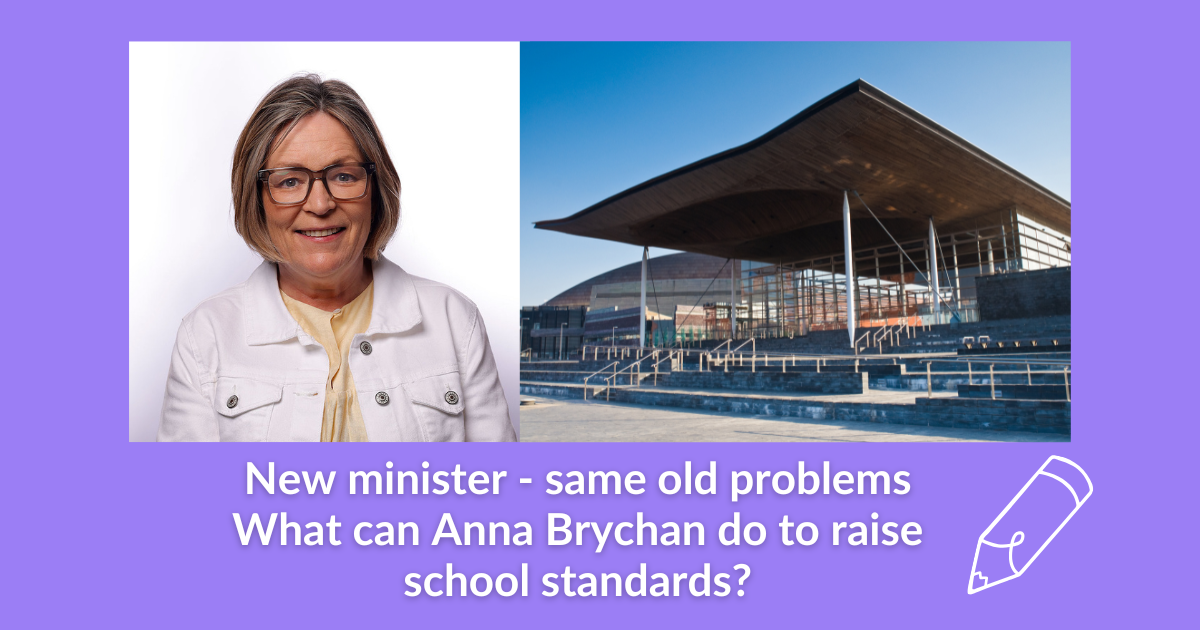
When Ms Brychan arrives at the education department, she will inherit an overflowing in-tray.
As we have argued many times before, education in Wales is facing deep and long-standing problems. Weak standards are only one part of a much broader crisis affecting schools, teachers and pupils alike.
Among the most pressing issues are:
- School funding
- Reading and literacy levels
- Educational outcomes
- Teacher recruitment and retention
- Additional Learning Needs (ALN) provision
- Attendance and behaviour
Recent international comparisons have intensified concerns about the direction of travel. Wales’ PISA results have consistently lagged behind other parts of the UK, particularly in reading and maths, while many schools continue to report growing difficulties around attendance, behaviour and staffing pressures.
At the same time, school leaders argue that rising demands are not being matched by adequate resources.
During our Impact Podcast election special, the former Plaid education spokesman Cefin Campbell repeatedly stressed the importance of improving the basics. Plaid Cymru’s manifesto also placed significant emphasis on literacy and numeracy, including proposals for a new foundational plan and the introduction of national and school-level targets.
Those commitments are positive and reflect the fact that standards in core skills in Wales are too low and must improve. However, they also raise an important political question.
Many of these same priorities were highlighted by the previous Labour-led Welsh Government, which only recently promised a revised literacy and numeracy framework, alongside various intervention programmes aimed at improving outcomes.
Yet despite years of new initiatives, many of the underlying problems remain unresolved.
The challenge for Ms Brychan, therefore, is not simply identifying the issues. It is demonstrating what Plaid Cymru will do differently, and how it intends to deliver measurable improvement where previous governments failed.
That task will be made harder by financial reality.
Like her predecessor, Ms Brychan is unlikely to benefit from any new funding. In practice, that means difficult decisions about how existing education budgets are allocated and whether current spending priorities are delivering value.
One thing Wales certainly does not need is another cycle of reviews, consultations and audits.
Instead, the new Cabinet Minister must look at where money is currently being spent and make the difficult decisions to ensure more of it reaches schools.
The children of Wales, parents, teachers and schools have no more time to waste. Change needs to happen and fast.
One area likely to attract scrutiny is Calon Cymru, the national literacy initiative that recently received an £8.2 million grant.
Reading sits at the heart of educational improvement. Strong literacy skills underpin attainment across the curriculum and are closely linked to wider outcomes, including confidence, behaviour and long-term opportunities.
But critics will question whether creating a national centre of excellence is the best use of limited resources at a time when schools themselves are under intense pressure.
An alternative approach would be to invest directly in a high-quality systematic synthetic phonics programme that could be rolled out consistently across schools in Wales, supported by robust professional learning for teachers.
Wales should also consider following England’s example by introducing the Year 1 Phonics Screening Check as a straightforward way of monitoring early reading development.
Beyond literacy, the disadvantage gap remains one of the biggest long-term challenges facing Welsh education. The gap in attainment between pupils from disadvantaged backgrounds and their peers remains stubbornly persistent, despite repeated attempts to narrow it.
Plaid Cymru’s proposed “Community Schools Plus” model, designed to bring together support around mental health, behaviour and wider family challenges, could help tackle some of the barriers that prevent disadvantaged pupils from thriving.
Ultimately, however, the new Welsh Government will be judged not by announcements or structural changes, but by actions and outcomes.
My message to Wales’ new Cabinet Minister for Education is simple: be bold.
A stronger education system is essential to Wales’ future prosperity and social wellbeing. But delivering meaningful improvement will require difficult choices, political courage and a willingness to move beyond familiar approaches.
Anything less risks falling short of the scale of the challenge.
*Image of Anna Brychan used under Creative Commons’ Attribution 4.0 International licence. The original image can be found here.