
Ask almost any teacher what issues affect their classroom practice the most and attention is always near the top of the list.
Some of the comments I’ve heard recently include:
- “Pupils’ attention spans seem to be getting shorter and shorter.”
- “They just can’t cope with multi-step instructions, or anything longer than a TikTok video.”
- “Pupils don’t seem able, or willing, to focus or keep going when things get tough.”
Teachers know attention is the gateway to learning, but gaining pupils’ attention and keeping it focused on the lesson at hand, is often one of the biggest challenges they face. Distractions can quickly become disruptions and before you know it valuable learning time has been lost.
Helping pupils to focus isn’t simply about improving classroom behaviour. It’s about creating the conditions in which learning can happen. If pupils are unable to pay attention to new information, think deeply about it and sustain their concentration, the chances of that learning being retained are greatly reduced.
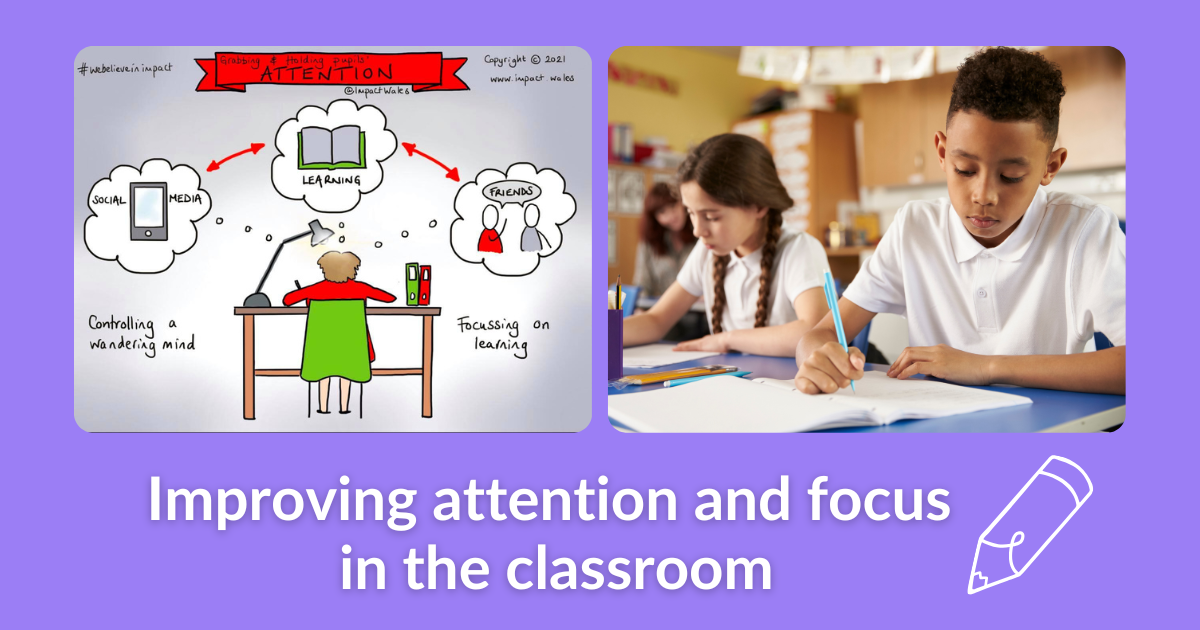
Digital distraction and classroom learning
Today’s pupils are growing up in a world full of competing demands for their attention. Smartphones and social media are designed to capture and hold our focus, making sustained concentration increasingly difficult, particularly for young minds.
Life has always been full of distractions, but the smartphone might be the biggest distraction we’ve yet invented. The powerful computer we carry in our pockets is constantly asking us to give it just a little more attention.
By the time children enter the classroom, many have already spent hours in environments built around immediate rewards and constant stimulation. Classroom learning is therefore competing with habits that work against deep concentration, making it harder for pupils to see challenging or repetitive learning as worthy of their attention.
That creates a hugely uneven playing field. Teachers are asking pupils to engage in activities that often require patience, persistence and sustained effort, while digital technologies encourage instant gratification and rapid shifts in attention.
Our job as teachers is not simply to help pupils resist distraction. We also need to teach them how to focus and sustain attention, even when learning feels demanding, repetitive or less immediately rewarding. Like reading, writing or problem solving, paying attention is a skill that can be developed with the right support and practice.
That’s exactly why I developed my new Improving Attention workshop. Using the latest research, it explores why pupils struggle to sustain attention and, more importantly, the practical strategies teachers can use to help them build stronger attention habits.
What does paying attention mean?
Understanding how attention works can help us design learning more effectively.
We cannot give our full attention to everything at once, and understanding this is crucial when planning effective teaching.
One helpful way of thinking about attention is through two different modes:
Spotlight attention is our ability to focus on one thing at a time, directing our mental effort towards a single task before moving on to the next.
Distributed attention, by contrast, involves spreading our focus across multiple sources of information or tasks.
Distributed attention can be useful when pupils are monitoring, adapting or drawing on knowledge they already possess. However, when pupils are encountering new material for the first time, learning usually requires sustained spotlight attention. Asking pupils to divide their attention between multiple sources of information too early can reduce the depth and accuracy of their thinking, making learning less likely to stick.
Every unnecessary distraction or competing source of information increases the cognitive demands placed on pupils, making it harder for them to focus on what matters most.
The problem arises whenever there are competing demands for our attention, whether they come from the classroom environment or from our own thoughts.
A distraction is a competing demand for our attention. An interruption is something that forces us to shift our attention away from the original goal altogether. Understanding this distinction helps create classrooms that support sustained attention rather than constantly competing for it.
What can we do as teachers?
Our first task is to help pupils pay attention to what we want them to learn. While that begins with paying attention to the teacher, the ultimate goal is for pupils to focus on the learning itself.
Although we can’t eliminate every distraction, we can do a great deal to reduce unnecessary ones. We can establish routines that support concentration, minimise competing demands for attention and explicitly teach pupils how attention works and why it matters.
We can also help pupils recognise when they are becoming distracted and equip them with practical strategies for regaining their focus. Over time, pupils can develop the habits and resilience needed to maintain their spotlight attention for longer periods, even when the work becomes difficult or boredom begins to creep in.
Improving attention is therefore not about expecting pupils to simply “try harder”. It’s about helping them understand the limits of attention, creating classrooms that support focus and concentration.
Improving Attention workshop
Are digital devices making it harder than ever for pupils to focus in school? What whole-school, departmental and classroom approaches can help children and young people develop stronger attention habits? And how can teachers design learning that captures, guides and sustains pupils’ attention from the beginning of a lesson to the end?
These are the questions explored in my Improving Attention workshop.
Drawing on the latest research – and my upcoming book, The Illustrated Pocket Guide to Focus & Attention: A Handbook for Teachers – this practical, evidence-informed session translates science into strategies that teachers can apply immediately in their own classrooms.
What You Will Learn
Participants will:
- Recognise the methods the brain uses to control focus and attention, but also the limitations of cognitive control
- Explore the difference between spotlight and distributed attention
- Examine the purpose of distractions and interruptions
- Consider the impact of environmental distractions, external interruptions, and episodes of ‘mind wandering’
- Explore how to use metacognition to develop good attention habits & greater resilience in learning
- Address the “boredom trap” and why novelty isn’t a solution to poor attention habits
Expected Outcomes
By the end of the workshop, participants will:
- Have a clear mental model of how cognitive control works and its limitations
- Be able to assess their own learning environments for distraction & interruption
- Have a bank of learning strategies that support focus and actively control attention
- Create a whole school action plan to improve attention and reduce the effect of digital distraction on learning
Who is it for?
The workshop is ideal for middle and senior leaders responsible for teaching and learning, as well as teachers who want to deepen their understanding of attention.
Whether you’re looking to improve your own classroom practice or develop a whole-school approach to attention and learning, the workshop provides practical ideas that can be implemented immediately.
To learn more about the workshop and to book your place, click here.
References
Cowan, N. (2001) ‘The magical number 4 in short-term memory: A reconsideration of mental storage capacity’, Behavioral and Brain Sciences, 24(1), pp. 87–185.
Hari, J. (2022) Stolen Focus: Why You Can’t Pay Attention – and How to Think Deeply Again. London: Bloomsbury Publishing.
Lin, L., Parker, K. and Horowitz, J.M. (2024) ‘Challenges in the classroom’, in What’s It Like To Be a Teacher in America Today? Pew Research Center, 4 April. Available at: Pew Research Center (Accessed: 5 August 2026)
Miller, E.K. (2000) ‘The prefrontal cortex and cognitive control’, Nature Reviews Neuroscience, 1, pp. 59–65 https://doi.org/10.1038/35036228
Miller, E.K. (2013) ‘The “working” of working memory’, Dialogues in Clinical Neuroscience, 15(4), pp. 411–418. https://doi.org/10.31887/DCNS.2013.15.4/emiller
Posner, M.I. (1980) ‘Orienting of attention’, Quarterly Journal of Experimental Psychology, 32(1), pp. 3–25
Schmidt, A.F., Gajewski, P.D. and Hildebrandt, A. (2024) ‘Is there a Flynn effect for attention? Cross-temporal meta-analytical evidence for better test performance (1990–2021)’, Personality and Individual Differences, 220, 112560. https://doi.org/10.1016/j.paid.2023.112560
Willingham, D.T. (2025) ‘Pay Attention, Kid! Has the use of digital technology impaired students’ ability to focus?’, Education Next, 25(4), 9 September. Available at: Education Next (Accessed: 5 August 2026)